

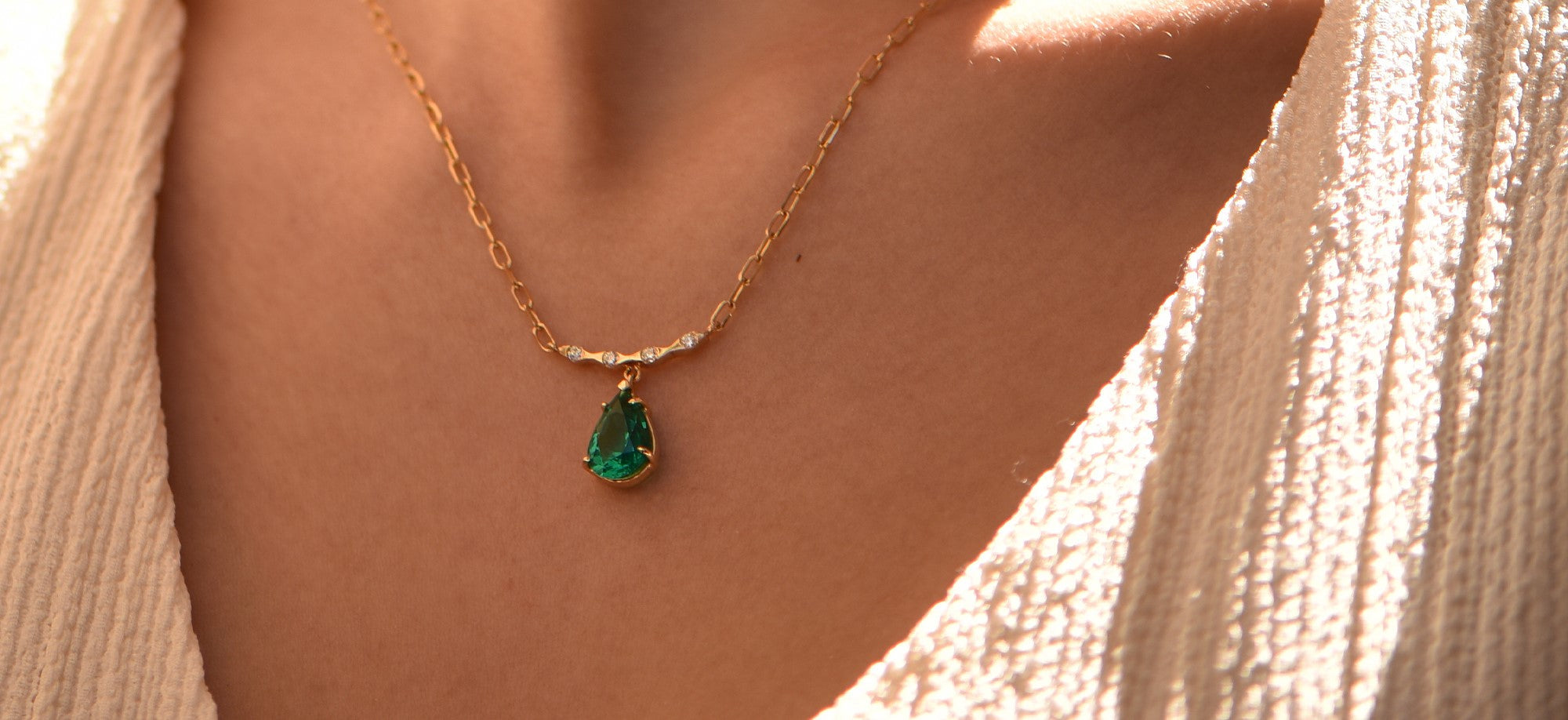
The Emerald: A Garden of History
Considered part of the very exclusive group of precious gemstones alongside sapphire, diamond and ruby, the emerald and its deep green color have inspired fascination for millennia. Known to humankind for a very long time, this gem has adorned jewelry and has even served as a means of exchange. Thanks to its beauty, it stands apart from other stones and has gained in value, reaching the rank of a precious gemstone. Its rarity makes it a coveted and appreciated stone in the world of jewelry. But what is its history, and how has its place in people’s hearts evolved?

Prisse Papyrus, Bibliothèque Nationale de France, 12th Dynasty, 1991–1785 BC.
The Emerald in Antiquity
Already known in ancient Egypt and Mesopotamia, the emerald carried strong symbolism. Whether associated with fertility or good fortune, this gem was already considered important and precious at the time.
In ancient Egypt, around 2400 BC, a certain Ptah-Hotep was already speaking of a “green stone” that was found only very rarely: “A perfect word is more hidden than the green stone,” he said in his teaching. This can therefore be seen as a clear reference to this precious stone, already highly appreciated in that region and period.
In ancient Greece, during the 4th–3rd centuries BC, Theophrastus and his treatise On Stones laid the foundations of mineralogy and described emeralds for the first time. At the time, mines in Upper Egypt and Austria were already being worked in search of the beautiful stone.
The Romans later associated it with Vesta, goddess of the hearth and sacred fire. Described at length by Pliny the Elder in his Natural History (1st century AD), emerald mines are said to have existed in many places, from Scythia and Ethiopia to Cyprus and Attica, with stones of varying quality. He even states that Emperor Nero, a great admirer of these gems, supposedly watched a gladiator fight through an emerald so as not to be bothered by the sun. There is little doubt that the emerald was appreciated and well known in Antiquity. It is nevertheless possible that it was confused with other stones, which could explain the wide variations described by Pliny.

Attributed to Jean Colombe, La Jérusalem Céleste, Apocalypse Figurée des Ducs de Savoie, exact date unknown, 15th century, painting on parchment, 41 × 26.5 cm, Escorial E Vit. 5 - Folio 49v.
Zmaragdu and the Bible
The emerald is also mentioned in the Bible. The main reference appears in Revelation (21:19), where the Heavenly Jerusalem and its foundations are described as being made of precious or fine stones. Emerald is among them, with the fourth foundation built from this gem. In the Christian tradition, the emerald therefore has its place under the name zmaragdu. Considered an important jewel, the stone was precious enough to be associated with the building of the New Jerusalem.
Eden Green
In Europe, during the Middle Ages and the early modern period, secular power increasingly asserted its authority over gemstones. Although they were studied in Western universities through theology, particularly by an urban bourgeois elite, diamonds in particular became the emblematic stone of the nobility. According to François Farges, a true “triptych” of precious colors emerged: blue, white and red, represented by sapphire, diamond and especially ruby/spinel/garnet. But what about green stones? Recalling the Garden of Eden, green is the Prophet’s favored color and enjoyed great popularity, particularly in the East. The emeralds available at the time were mainly sourced from the Thebaid in Egypt, from mines known as the “Cleopatra Mines.” The “princes of Islam” competed for these emeralds as they became increasingly difficult to find, especially as the location of the ancient deposit was gradually forgotten in the East.
It is interesting to note the relationship between minerals and power and the consequences that followed. The Church, for example, placed greater emphasis on color than on the preciousness of the stone itself. As a result, ecclesiastical objects from this period were generally adorned with semi-precious stones or even colored glass.

Photo: Javier Hinojosa - INAH, gold crocodile set with emeralds, found in Mexico.
In Pursuit of the Emerald
Around the world, the emerald fascinated many peoples, and the Inca and Muisca groups were no exception when it came to attributing great value to the stone. Long before the arrival of the conquistadors, South American civilizations regarded emeralds as special stones and attributed specific virtues to them, such as fertility among the Incas.
During the Spanish conquest of the 16th century, Hernán Cortés, conqueror of the Aztec Empire, is said to have kept several emeralds from Montezuma’s treasure and given them to his wife, Doña Juana de Zúñiga. According to Francisco López de Gómara, a 16th-century Spanish historian, the five emeralds were cut into different forms, including a rose and a fish. They are even said to have aroused the jealousy of the Empress of Spain, but ultimately sank in the Mediterranean after a shipwreck when Cortés set sail for Algiers.

Green Athena’s Wisdom by AGUAdeORO
The Green Frenzy
In the 19th century, Empress Joséphine, Napoleon Bonaparte’s first wife, adored emeralds and owned several magnificent pieces set with these stones. Later, Princess Diana made headlines in 1985 when she wore a necklace as a tiara during a tour of Australia. The necklace, which had belonged to Queen Mary, is adorned with numerous emeralds in a strongly Art Deco style and is considered to have expressed Princess Diana’s individuality that evening.
Another story involving emeralds concerns the coronation and later exile of Iran’s royal family. In 1971, Empress Farah wore Empress Eugénie’s emeralds at the legendary Persepolis celebrations, together with an emerald crown. Considered the celebration of the century, this period did not last: Iran’s royal family was forced to flee in 1979 during the revolution. The emeralds have since been kept at the Central Bank in Tehran.

Rainforest Blossom, featuring a splendid 0.75-carat pear-shaped emerald set in an 18k yellow-gold ring, accompanied by five round emeralds and eight round blue sapphires. All of the stones are lab-grown.
The Emerald Today
The birthstone for May, the emerald is one of the rarest precious gems and is often filled with natural inclusions known as “gardens,” giving each stone a unique character. Considered gemstones of great beauty, with a distinct identity of their own, emeralds have dazzled people for centuries and continue to surprise. They remain an essential gem in the world of jewelry.
Having evolved from a stone of high symbolic value and great prestige, the emerald has nevertheless lost much of its former symbolism while retaining a privileged place in the hearts of connoisseurs. Increasingly difficult to find, it remains highly appreciated for its magnificent intense green color, which creates challenges of supply and demand. This evolution in how the stone is perceived is significant today: it is now viewed as a sign of prestige because of its rarity rather than, for example, as a symbol of fertility. Rarer than diamond, which is certainly a precious stone but comparatively easier to find, the more elusive emerald continues to delight an informed audience.
Today, emeralds remain among the most sought-after gemstones in their natural state. Colombia remains the world’s leading producer, but emeralds are also mined in other regions, including Brazil, Zambia and Zimbabwe. Unfortunately, emerald mining, particularly in Colombia, raises a number of social issues. You can learn more in our article “Colombia: the emerald at the heart of violence”.
It is now possible to obtain emeralds from controlled environments, avoiding the problems associated with mining. These new laboratory-grown gems have the same characteristics as natural stones without the harmful social and environmental implications associated with mined stones. AGUAdeORO jewelry made with emeralds that are not extracted from mines avoids problems linked to extraction such as corruption, wars and the disillusionment of vulnerable mining communities.
The stories surrounding these stones are mostly magnificent, but does that mean we should encourage mining, which carries so much hardship? Socially, it is a real disaster, with a parallel economy that benefits ill-intentioned cartels and intermediaries. Miners generally receive little for their hard work and continue, day after day, hoping to find the stone that will change their lives.
AGUAdeORO is a jewelry house founded in 2009 and present in Geneva and Zurich, offering clients the opportunity to acquire ethical jewelry made in Switzerland. We are committed to offering jewelry that combines sustainable development and elegance.
Read more
Recently, Kate Middleton was seen in a video wearing a ring different from her engagement ring. Instead, she wore a simpler band set with her own and her husband William’s birthstones. More symboli...
Emerald, a fascinating precious stone and a symbol of love and renewal, shines through its vibrant colour and unique inclusions. Less hard but more fragile than diamond, it requires attentive care....