

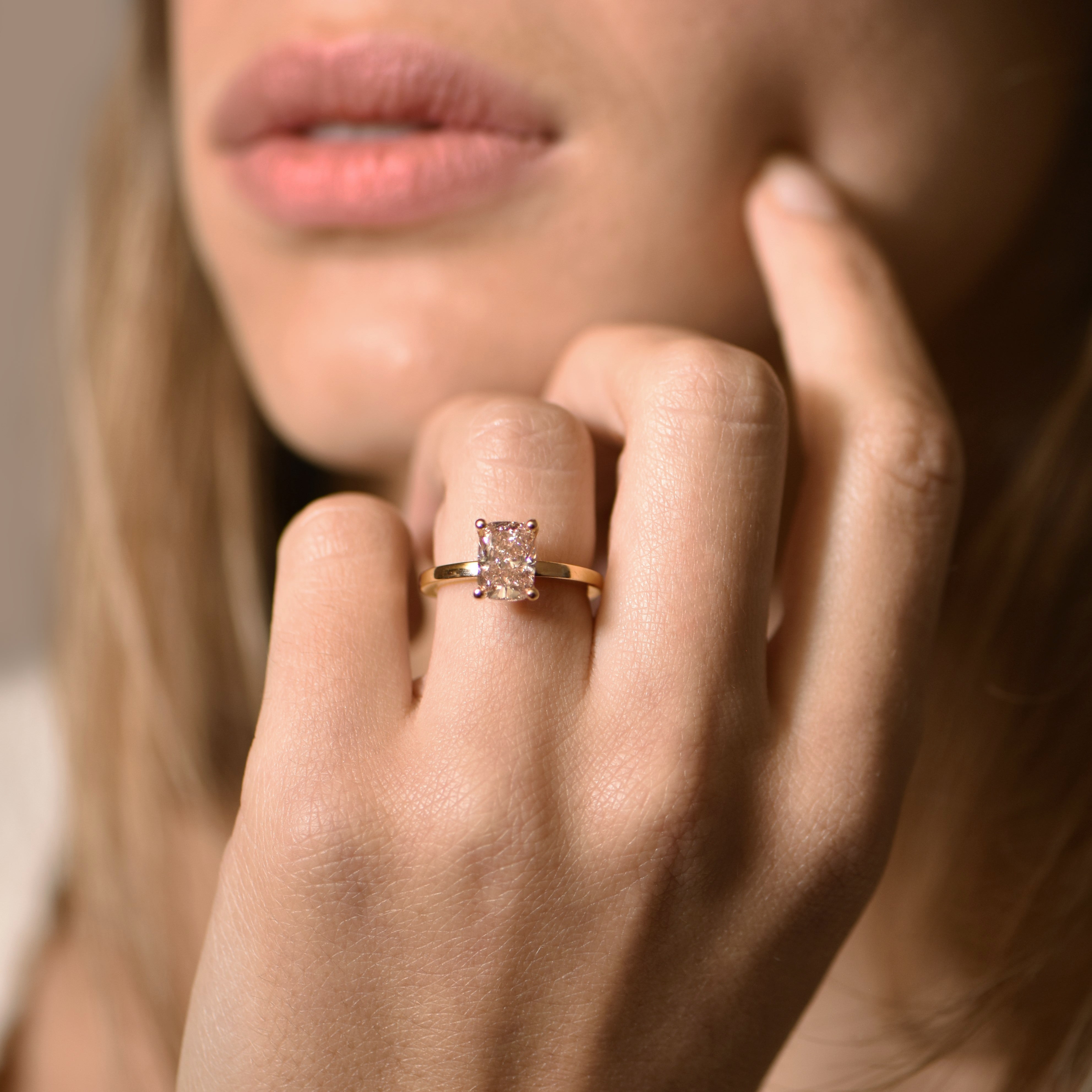
18k or 14k: Why Your Engagement Ring Is Never Made of 24K Gold
Brilliant, rare and resilient, gold has always been a universal symbol of beauty, power and legacy. This precious metal lies at the heart of jewellery, whether in everyday jewellery, wedding bands or engagement rings. Yet behind this timeless brilliance lie many differences between cultures: not all gold is considered equal, and its composition, measured in karats, varies greatly from one country to another. These karat values reflect local traditions, as well as alloy choices that influence the colour, strength and symbolism of a jewel. True to its values, AGUAdeORO works exclusively with Fairtrade gold: a precious material from an ethical supply chain that respects mining communities and the environment.
Karat: a universal measure
The term “karat” (not to be confused with the carat used for gemstones) refers to the proportion of pure gold contained in an alloy. The unit is based on a division into 24 parts. Thus:
- 24 karats: 99.9% pure gold
- 22 karats: 91.6% gold
- 18 karats: 75% gold
- 14 karats: 58.5% gold
- 9 or 10 karats: between 37.5% and 41.7% gold
Alloys: why add other metals?
The purer the gold, the softer it is. While 24-karat gold dazzles with its deep yellow-orange colour and rarity, its great malleability makes it unsuitable for everyday wear. This is why high jewellery prefers 18-karat gold: a subtle balance between the nobility of the metal and resistance, achieved through an alloy of 75% pure gold and metals such as silver, copper, zinc or palladium. These alloys influence not only the strength of the jewel, but also its colour: sunny yellow, luminous white or coppery red. Each karat value responds to specific traditions, sensibilities and cultural uses, giving designers a palette of shades and textures with which to create unique pieces.
Why is gold purity measured in 24 karats?
The unit used to define gold purity, the karat, is said to have its origins in traditions dating back thousands of years. But why is the purity of gold measured on a 24-karat scale?
The choice of the number 24, the basis of the gold-karat system, dates back to Antiquity. In Mesopotamian, Indian and Egyptian civilizations, trade relied on non-decimal numerical systems, often duodecimal (base 12) or sexagesimal (base 60). The number 24, a multiple of 12, became established because it could be divided smoothly by 2, 3, 4, 6, 8 or 12. This allowed goldsmiths and merchants to divide gold alloys precisely, long before the invention of the calculator.
Thus, when an engagement ring is made of 18-karat gold, it means that it contains 75% pure gold (18/24), the remainder being an alloy of metals such as copper, zinc or silver. This type of gold alloy strengthens the jewel while subtly modifying its colour: yellow gold, rose gold or white gold. Pure gold, or 24-karat gold, although exceptional for its yellow-orange colour, is too malleable for everyday use.
The 24-karat system has also endured thanks to its connection with ancient weight systems, such as the troy ounce used for precious metals, divided into 480 grains, another easily divisible measure.
Today, this tradition continues in contemporary jewellery. At AGUAdeORO, every jewel, whether a wedding band or an engagement ring, is made in 18-karat Fairtrade-certified gold, ethical gold extracted with respect for people and nature. Karatage therefore becomes much more than an indication of purity: it reflects ancestral expertise combined with a responsible and sustainable commitment.
Gold around the world
Preferences in terms of karat vary across regions of the world, influenced by history, traditions and everyday uses.
18-karat gold: a perfect balance for European high jewellery
An essential reference in luxury jewellery, 18-karat gold is composed of 75% pure gold alloyed with other precious metals to reinforce its strength. This karat value is widely used in Europe for high-end jewellery, particularly engagement rings, wedding bands and exceptional pieces. Its balanced brilliance, robustness and long-lasting wear make it a prized alloy for jewellery houses that combine aesthetics and durability.
22- and 24-karat gold: the prestige of Eastern and ceremonial traditions
In Asian and Middle Eastern cultures, exceptionally pure 22- or 24-karat gold is favoured for its deep yellow colour and sacred symbolism. This almost pure gold is often reserved for wedding ornaments, ceremonial necklaces and heritage bracelets. In India, China and the Gulf countries, giving 24-karat gold for a wedding or birth is a highly symbolic gesture, a guarantee of prosperity and cultural roots. Although this type of gold is more malleable, it remains one of the most sought-after for wedding jewellery with traditional and heritage values.
14- and 10-karat gold: durable and accessible everyday jewellery
Less noble but very widespread in Anglo-Saxon countries such as the United States and Canada, 14-karat gold (58.5% pure gold) and 10-karat gold (41.7%) are appreciated for their strength and more accessible price. These alloys are often chosen for jewellery worn every day: rings, necklaces or earrings. Their resistance to wear makes them practical allies for an active lifestyle. Although less common in high jewellery, these karat values offer an interesting alternative for those seeking durable jewellery without compromising on design.

22-karat gold jhumkas, essential at weddings and major celebrations in certain Indian cultures. An iconic jewel combining tradition and brilliance. (Photo by v.govindaraj raj on Unsplash)
The hallmark: gold’s signature
In European countries, and particularly in Switzerland, hallmarking is a legal and aesthetic guarantee. It makes it possible to authenticate the precious metal, its gold content and its origin. Two hallmarks are generally visible on a jewel:
- The fineness hallmark, indicating the gold content.
- The maker’s or brand hallmark, specific to the workshop or Maison.
At AGUAdeORO, each creation proudly bears the 750 hallmark, guaranteeing its composition in 18-karat gold, as well as our exclusive AGUAdeORO hallmark, proof of authenticity, ethics and Swiss craftsmanship.

The Fairy-Tale Blossom ring in 18-karat yellow gold with its AGUAdeORO and Fairtrade hallmarks. At its centre is a cultured pink sapphire in a round brilliant cut and a halo of cultured diamonds.
Curiosities about gold
- Ancient Egypt: the beginnings of the “gold standard”
As early as 2600 BC, the Egyptians excelled in the art of goldsmithing. They called gold nub, giving its name to Nubia, the gold-bearing region par excellence. Pharaohs were buried with 24-karat gold amulets believed to ensure their eternity. - India, birthplace of the 24-karat system
The division of pure gold into 24 parts has its origins in ancient India. Sanskrit texts already mentioned this way of assessing purity. This ingenious system spread westward through trade routes. - Rome and the aureus: the imperial gold coin
Under Julius Caesar, the Roman Empire minted the aureus, a pure gold coin weighing nearly 8 grams. A symbol of power and stability, it left a lasting mark on European monetary history. - Medieval alchemists and the quest for perfect gold
In the Middle Ages, alchemists sought to transform ordinary metals into 24-karat gold using the legendary Philosopher’s Stone. A fruitless quest, but one that led to numerous advances in chemistry. - Seeds for weighing gold: the botanical origin of the carat
In ancient markets, carob seeds (Ceratonia siliqua) were renowned for their constant weight. They were used as a reference for weighing gold, giving rise to the term carat. - Gold, the divine metal of ancient civilizations
Among the Incas, Aztecs and Mesopotamians, gold was not merely a precious metal: it symbolized the divine. Nicknamed “the sweat of the sun”, it embodied celestial power and closeness to the gods. - Napoleon’s engagement ring: the power of a symbol
Napoleon gave Joséphine a simple gold ring without a precious stone. Today, this understated jewel is worth more for its historical significance than for its weight in karats. - Gold rushes: when the world rushed toward wealth
Gold fever shaped entire nations: from California (1848) to Australia (1851), the attraction of this precious metal transformed the economy, migration and the history of humanity.
AGUAdeORO is a jewellery house founded in 2009, with locations in Geneva and Zurich, offering clients the opportunity to acquire ethical jewellery made in Switzerland. We are committed to offering jewellery that combines sustainable development and elegance.
Read more
Abandoned diamond mines leave behind disfigured landscapes, destroyed biodiversity and neglected communities. In response to this legacy, AGUAdeORO is committed to ethical jewellery, using exclusiv...
The diamond market is undergoing profound change. As natural diamonds see their value plummet, lab-grown diamonds are emerging as an ethical, sustainable, and transparent alternative. This AGUAdeOR...
Leave a comment
All comments are moderated before being published.
This site is protected by hCaptcha and the hCaptcha Privacy Policy and Terms of Service apply.